
The open-source agent space is moving fast, and two of the most interesting projects right now are Nous Research’s Hermes Agent and OpenClaw.
At first glance, they seem very similar. Both are self-hosted. Both can connect to tools. Both can live across messaging channels. Both aim to become persistent AI systems rather than one-shot chatbots.
But once you look closer, the difference becomes clear.
My simplest summary is this:
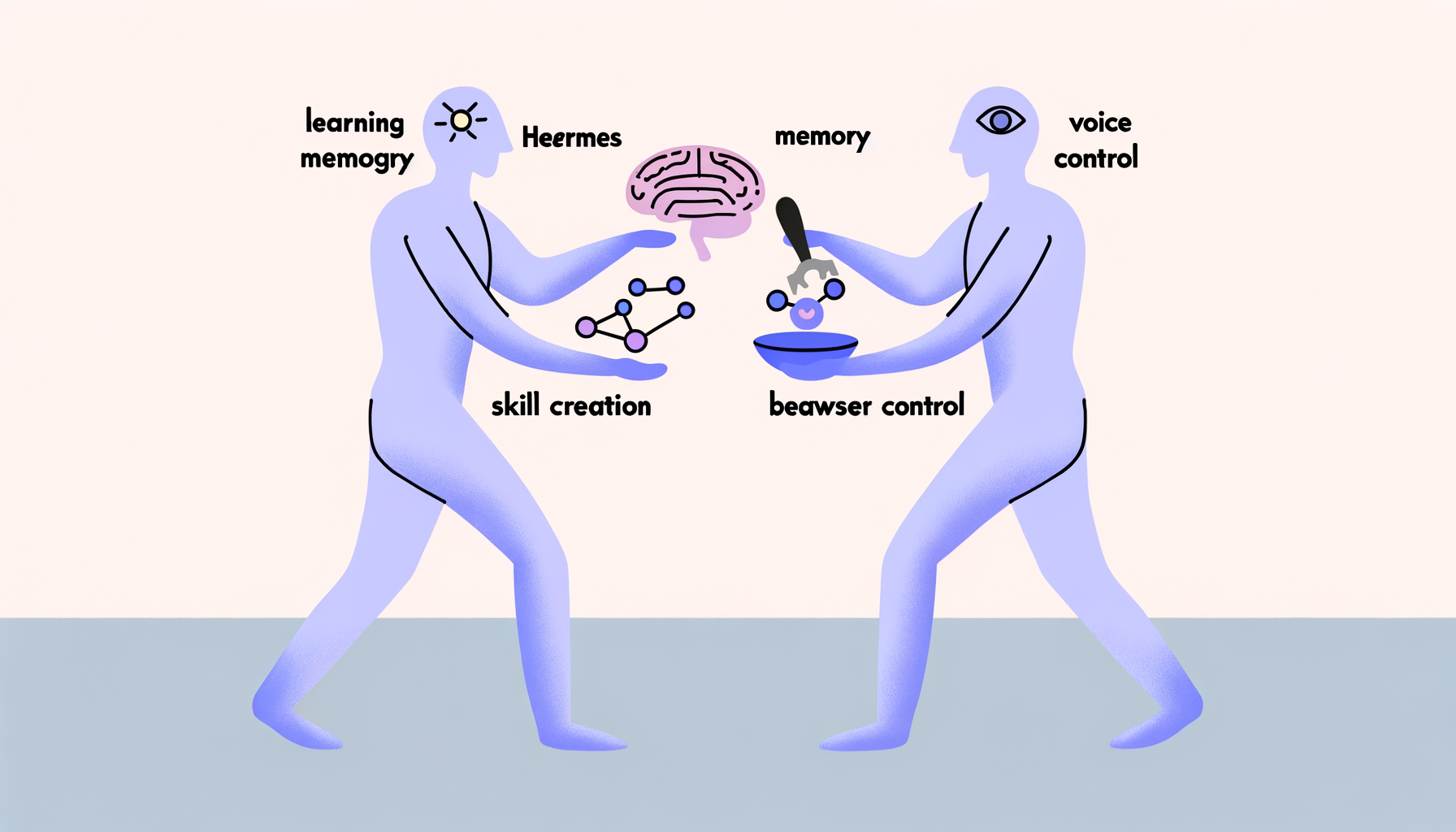
Hermes Agent is the better agent brain. OpenClaw is the better personal assistant body.
One is more focused on learning, memory, skill creation, and long-term autonomy. The other is more focused on channels, devices, voice, browser control, and everyday assistant-style usability.
1) The philosophical difference
Hermes Agent presents itself as a self-improving AI agent. Its core promise is not just that it can use tools, but that it can learn from experience, create skills, improve those skills during use, search its own past conversations, and build a deeper model of the user over time. That makes Hermes feel less like a chatbot and more like a persistent digital worker or teammate.
OpenClaw, by contrast, positions itself as a personal AI assistant you run on your own devices. Its emphasis is not only on intelligence, but on presence: it should live in the channels you already use, speak and listen on your devices, render interactive surfaces, and act inside your daily environment.
That is why the two projects may overlap technically, yet still feel like different products. Hermes feels like an agent platform. OpenClaw feels like a personal assistant operating layer.
2) Channels and communication surfaces
OpenClaw is especially strong here. Its official materials emphasize support for a very broad set of channels, including WhatsApp, Telegram, Slack, Discord, Google Chat, Signal, iMessage/BlueBubbles, Teams, Matrix, WebChat, and more. That makes it compelling for anyone who wants an assistant embedded directly into their existing communication habits.
Hermes also supports multiple communication surfaces, including Telegram, Discord, Slack, WhatsApp, Signal, and CLI-style interaction. But its message is less about sheer channel breadth and more about being a persistent agent that keeps working for you wherever it runs.
If channel diversity is the main criterion, OpenClaw has the edge.
3) Voice, mobile, and device integration
This is one of OpenClaw’s clearest strengths. Its public positioning highlights the ability to speak and listen on macOS, iOS, and Android, along with interactive surfaces like live Canvas. In other words, it is trying to be more than a remote agent. It is trying to become a real assistant layer across your devices.
Hermes supports personal continuity too, but the spotlight is elsewhere: learning loops, memory, skill evolution, and persistent cloud-style execution. So if what you want is a device-native assistant experience, OpenClaw feels more naturally shaped for that role.
4) Memory and long-term improvement
This is probably the most important difference between the two.
Hermes Agent puts learning at the center of the product. Its ability to search past conversations, build a deepening user model, generate skills from recurring experience, and improve those skills over time makes it far more ambitious than a typical tool-calling assistant. If your goal is to have an agent that becomes more useful month after month, Hermes is the more exciting direction.
OpenClaw has a skills layer as well, and it clearly supports extensibility. But its product narrative is much more centered on channels, control planes, device access, and assistant-like interaction. So on the axis of long-term agent memory and self-improvement, Hermes looks stronger.
5) Browser control and real-world action
One of OpenClaw’s most compelling features is how directly it embraces browser control and real system interaction. That matters because it pushes the project beyond “responding intelligently” and toward “actually doing things on your behalf.” Since it runs on infrastructure you control and can be given meaningful permissions, the assistant idea becomes more concrete.
Hermes has strong tooling, terminal support, and extensibility too. But browser control and embodied assistant behavior are not as central to its public identity. So for browser use, computer use, and daily assistant automation, OpenClaw feels like the more natural fit.
6) Deployment model
Hermes Agent stands out in how explicitly it is designed not to live only on your laptop. Its documentation and README emphasize running on cheap VPS instances, cloud machines, GPU clusters, and even low-cost serverless setups. That makes it feel like an always-on remote worker.
OpenClaw is also self-hosted and flexible, but its overall shape feels more like a personal assistant mesh around your devices and communications. Both can run remotely, but Hermes feels more cloud-agent-native in spirit.
7) So which one should you choose?
The answer depends on what you really want: Do you want a digital worker, or a personal assistant?
If you want something that learns over time, develops and improves skills, builds memory, acts more autonomously, and runs persistently on a VPS or in the cloud — then Hermes Agent is probably the better choice.
If you want something that lives inside WhatsApp, Telegram, Signal, or similar apps, feels more tied to your phone and devices, works naturally with voice, integrates browser and local system control, and behaves more like an assistant embedded in daily life — then OpenClaw is probably the better choice.
Final take
My view is simple:
Hermes Agent offers the more advanced agent vision. OpenClaw offers the more tangible personal assistant experience.
And the fact that Hermes explicitly talks about migrating from OpenClaw is itself revealing: these two are not random unrelated projects. They sit close to one another, but with different centers of gravity.
So the cleanest summary is still:
Hermes = better agent brain
OpenClaw = better assistant body
And the most powerful future product will probably be the one that combines both.
Leave a Reply