
When people first encounter OpenClaw, they often ask a simple question: what exactly are its main building blocks? Is it just an agent runtime? Is it about memory? Is SOUL.md the core? Or is it something bigger?
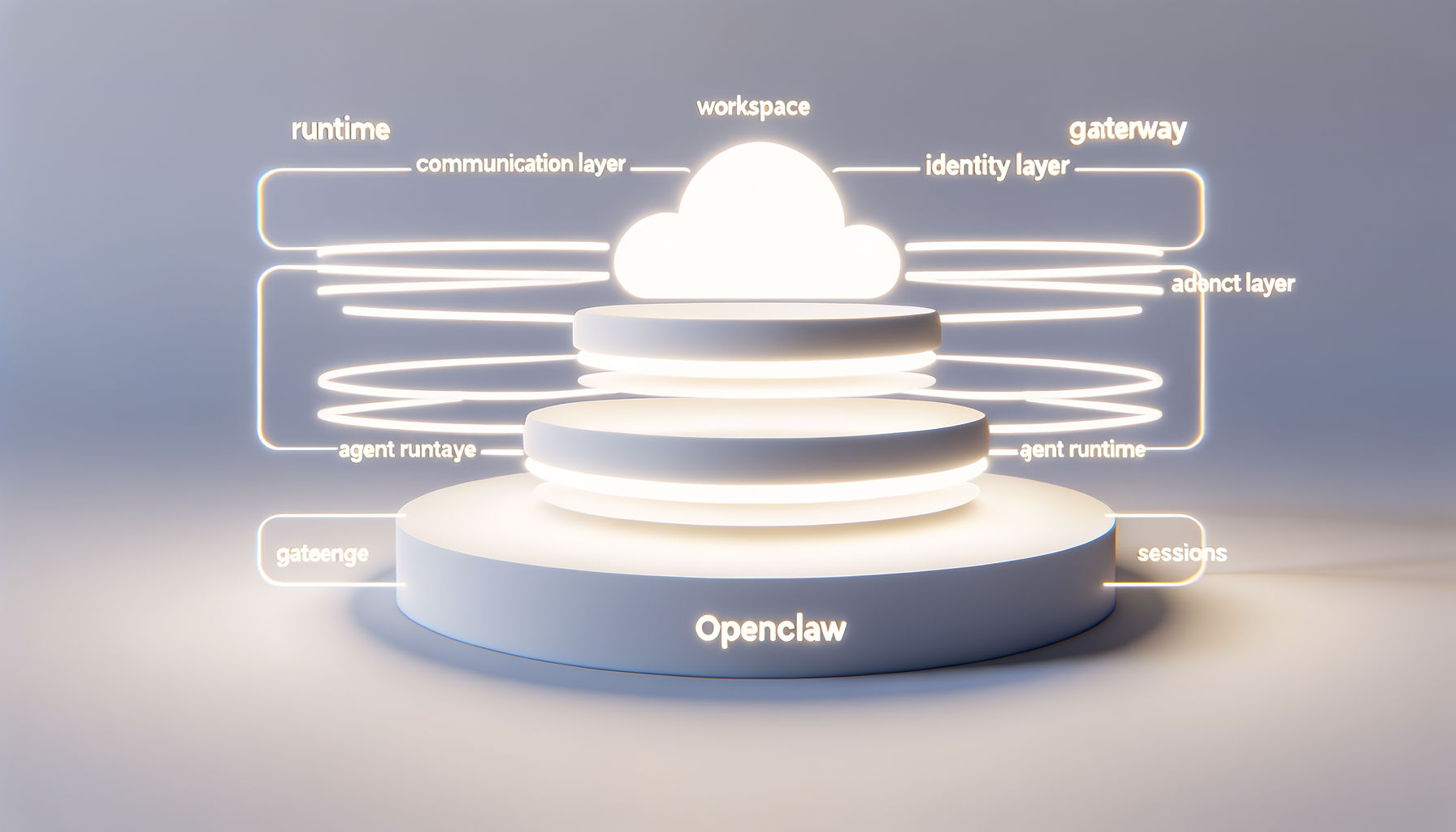
The answer is: OpenClaw is built as a layered agent system. Some parts define the agent’s identity and behavior, while others handle execution, communication, memory, and tools. To understand OpenClaw properly, it helps to look at it not as a single app, but as a living architecture made of several complementary parts.
OpenClaw as a layered system
At a high level, OpenClaw can be understood in two major layers.
The first is the runtime and communication layer. This is the operational side of the system: message routing, channels, sessions, tool execution, and the overall agent loop.
The second is the workspace and identity layer. This is where the agent’s character, memory, instructions, and persistent context live. This is also where files like SOUL.md, USER.md, AGENTS.md, and MEMORY.md come in.
That distinction matters, because OpenClaw is not just “an LLM with memory.” It is an agent environment where personality, instructions, tools, and state are all structured explicitly.
Gateway: the central nervous system
One of the most important pieces in OpenClaw is the Gateway. If you want a simple analogy, the Gateway is the system’s central nervous system.
It is responsible for keeping communication channels alive, routing events, managing sessions, and connecting user messages to the actual agent runtime. In other words, it is the orchestration layer that allows the whole system to function as a coherent agent platform rather than a loose collection of scripts.
Without the Gateway, the rest of the components would exist, but they would not feel unified.
Channels and connectors: where conversations happen
OpenClaw is designed to operate across multiple surfaces. These include messaging and chat environments such as Slack, Telegram, Discord, WhatsApp, and other integrations.
These channels act as the outer interface of the system. They receive incoming messages from users and deliver the model’s responses back to them. In practical terms, they are the “ears and mouth” of OpenClaw.
This makes OpenClaw more than a local agent framework. It becomes something that can inhabit real communication environments.
The agent runtime: the thinking and acting engine
Once a message arrives through a channel and is routed by the Gateway, the work moves into the agent runtime.
This is the part that assembles context, invokes the model, decides when tools should be used, streams results, and produces the final response. If the Gateway is the nervous system, the runtime is the part that actually thinks and acts.
This is where the agent loop takes shape: intake, context construction, reasoning, tool use, response generation, and persistence.
Sessions: continuity across interactions
Another important concept in OpenClaw is the session.
Sessions allow the system to maintain continuity across conversations. Instead of every message being a completely isolated prompt, a session provides a container for context tied to a particular user, channel, or interaction thread.
That continuity is crucial for agent behavior. It allows the system to remember what kind of conversation it is in, whom it is talking to, and what has already been established.
Workspace: the agent’s persistent home
If there is one concept that makes OpenClaw feel especially distinctive, it is the workspace.
The workspace is the persistent directory where the agent’s core files live. Rather than hiding everything inside a database or opaque internal state, OpenClaw externalizes much of the agent’s identity and memory into readable files.
This is a powerful design choice. It makes the agent more inspectable, more editable, and more understandable. Instead of asking, “What is the model thinking internally?”, you can often look at the workspace and see what shapes its behavior.
SOUL.md: the ruh (soul) of the agent
Among all these files, SOUL.md is probably the most symbolically important one.
If we translate it conceptually into Turkish, it is the agent’s ruh, while still keeping the original file name SOUL.md because that is how the platform refers to it.
SOUL.md defines the deeper character of the agent: its tone, its stance, its values, and the kind of presence it should have. It is not merely a style guide. It is closer to a personality anchor.
That is why many people intuitively gravitate toward SOUL.md first when they study OpenClaw. It feels like the file that answers the question, “Who is this agent?”
USER.md: who the agent serves
If SOUL.md helps define who the agent is, USER.md helps define who the agent is serving.
This file captures user-specific context: preferences, naming conventions, expectations, and other information that personalizes the relationship. It creates a bridge between a general-purpose agent and a specific human being.
In that sense, USER.md is not about the agent’s identity, but about the agent’s orientation toward the person on the other side.
AGENTS.md: the operating constitution
Another key file is AGENTS.md.
This can be thought of as the agent’s operating constitution. It defines how the agent should work, what priorities it should maintain, how it should use memory, and how it should behave in practice.
If SOUL.md is the agent’s ruh, then AGENTS.md is closer to its operating doctrine.
That distinction matters. A good agent is not only a personality. It also needs a clear operational framework.
MEMORY.md and daily memory files
Then comes one of the most discussed pieces: memory.
In OpenClaw, memory is not treated as vague hidden magic. It is structured explicitly through files such as MEMORY.md and date-based memory files like memory/YYYY-MM-DD.md.
This design gives memory both a long-term and short-term character. MEMORY.md can function as curated durable memory, while daily files act more like episodic logs or recent notes.
That means memory in OpenClaw is not just “recall.” It is a maintained layer of persistent context.
TOOLS.md and skills: what the agent can do
An agent is only as useful as its capabilities. That is where TOOLS.md and the broader skills ecosystem enter the picture.
TOOLS.md can describe tool usage, conventions, and operational guidance. Skills extend the agent beyond basic conversation, allowing it to perform more specialized tasks.
So if SOUL.md shapes the agent’s character and MEMORY.md shapes its continuity, tools and skills shape its practical usefulness.
IDENTITY.md: name, presentation, vibe
There is also IDENTITY.md, which helps define how the agent presents itself.
This is related to SOUL.md, but it is not exactly the same thing. SOUL.md is deeper and more behavioral; IDENTITY.md is more about name, presentation, and outward flavor.
A useful way to think about it is this:
- SOUL.md = inner character, or ruh
- IDENTITY.md = external presentation
Together, they help the agent feel coherent rather than generic.
Auxiliary files like BOOTSTRAP.md and HEARTBEAT.md
OpenClaw also includes supporting files such as BOOTSTRAP.md and HEARTBEAT.md.
These are not usually the first files people focus on, but they still matter. They help define initialization, ongoing operational state, and the broader lifecycle of the agent.
So while they may not be as iconic as SOUL.md or MEMORY.md, they are still part of the system’s architecture.
So what are the main components, really?
If we simplify everything, OpenClaw’s main components can be grouped like this:
- Gateway: orchestration and routing
- Channels / connectors: communication surfaces
- Agent runtime: reasoning, execution, and responses
- Sessions: continuity across interactions
- Workspace: persistent home for the agent
- SOUL.md: the agent’s ruh, or soul
- USER.md: the user-facing context
- AGENTS.md: operational instructions and doctrine
- MEMORY.md and daily memory files: long-term and episodic memory
- TOOLS.md and skills: capabilities and extensions
- IDENTITY.md: name and outward presentation
This is why it would be incomplete to say OpenClaw is only about “soul” or only about “memory.” Those are important parts, but they sit inside a broader architecture.
Final thought
What makes OpenClaw interesting is not just that it has memory, tools, or a configurable personality. Many systems aim for those things. What makes it distinctive is that these pieces are structured in a more explicit, file-oriented, inspectable way.
That gives the platform a different feel. Instead of a black box assistant, OpenClaw starts to resemble a composed digital being: one with a runtime, a workspace, a ruh (SOUL.md), an identity, instructions, and memory.
And that is probably the cleanest way to understand it:
OpenClaw is not a single component. It is an architecture where identity, memory, execution, and communication are all first-class citizens.
Leave a Reply